The Breakfast Cereal Scandal

The Race To The Bottom Continues

Author: Dr. Stephen Chaney

Factory FarmBig Food Inc is not your friend. Big Food Inc follows the latest trends and is only too happy to give consumers what they want.

You want low-fat? No problem. You want low-carb, natural, organic, non-GMO, gluten-free, Paleo, Keto? No problem. However, their motive is a healthy bottom line, not your health.

They know humans are hardwired to desire sugar, salt, and fat. Foods with those ingredients sell. Convenience sells. At the end of the day, they are more interested in sales than they are in your health.

They don’t want you to buy whole foods and cook them from scratch. They don’t make money from whole foods. They want you to buy their pre-packaged convenience foods instead.

A prime example of how Big Food Inc of how Big Food takes a healthy food and turns it into a nutrition disaster is what I call “The Breakfast Cereal Scandal”.

The Great Breakfast Cereal Scandal 
It’s hard to believe that breakfast cereals started as health food, but they did. Dr. John Harvey Kellogg was a Seventh-day Adventist who took over the Western Reform Health Institute in 1877 and renamed it the Battle Creek Sanitarium.

It gained prominence as a health resort where people went to be healed through a combination of physical activity and healthy eating.

Dr. Kellogg invented Corn Flakes in 1878 as a healthier alternative to the high-fat breakfasts most Americans were consuming at that time. Corn Flakes had less than 5% sugar. It was a great idea for its time, but what happened next is nothing short of appalling.

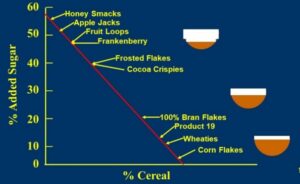
It is a perfect example of how Big Food Inc leads us astray. The graphic above that I created illustrates what the major food companies have done to breakfast cereals over the decades since then.

It all started with Corn Flakes. Then other food companies started bringing out competing products. Cereals like Wheaties and Rice Krispies were still pretty healthy, but they had a bit more sugar, which gave them better consumer appeal.

As soon as the food companies figured out that sugar increased their sales, the race was on. The percentage sugar increased to 40%, then to 50%, and now to almost 60%.

No sane parent would fill their child’s cereal bowl half full of sugar, but that is exactly what they are doing when they feed them some of today’s breakfast cereals. The food companies are hiding the outrageous sugar content of their cereals with slogans like “Just a touch of honey.”

Speaking of deception, can anyone tell me how you label a product with 20% sugar 100% Bran Flakes?

I created the graphic above in the 1990’s. At that time, I assumed breakfast cereals couldn’t get much worse. But I was wrong. Big Food’s “race to the bottom” continues.

A recent study (A Zhao et al, JAMA Network Open, 8(5): e2511699, 2025) examined the nutritional content of children’s cereals introduced to the US market between 2010 and 2023.

How Was This Study Done? 

Clinical StudyThe investigators used data from the Mintel Global New Products Database, which tracks new product launches for foods and beverages. From this database they identified 1,200 new children’s cereals introduced in the US market from 2010 through 2023.

Children’s cereals were defined as breakfast cereal products explicitly marketed (through packaging or branding) to children between 5 and 12 years old.

Using product label information, they compared the total fat, sodium, total carbohydrate, sugar, protein, and dietary fiber per serving and analyzed the trends between 2010 and 2023.

The Race To The Bottom Continues

If the previous decline in nutritional value of breakfast cereals between the 1870s and 1970s can be described can be described as “appalling”, the latest results can only be described as scandalous.

For newly introduced children’s breakfast cereals in the 13 years between 2010 and 2023,

  • Fat content increased 34%.
  • Sodium (salt) content increased 32%.
  • Sugar content increased by 11%.
  • Protein content decreased by 11%.
  • Fiber content decreased by 30%.

The authors of the study concluded, “Analysis of newly launched children’s RTE (ready to eat) cereals from 2010 to 2023 revealed concerning nutritional shifts: notable increases in fat, sodium, and sugar along decreases in protein and fiber.

Children’s cereals contain high levels of added sugar, with a single serving exceeding 45% of the American Heart Association’s daily recommended limit for children.

These trends suggest a potential prioritization of taste over nutritional quality in product development, contributing to childhood obesity and long-term cardiovascular health risks.”

In short, despite the American public’s increasing interest in a healthy diet, Big Food is still prioritizing sales over healthy foods. The race to the bottom continues.

What Does This Mean For You?

The take home lesson is clear. Don’t trust Big Food with your health. Their priority is sales, not your health.

Even when they claim their processed foods are healthy because they have removed fat or sugar, they have simply replaced them with a witch’s brew of chemicals so they look, taste, and smell delicious.

And breakfast cereals are just the tip of the iceberg. For most Americans 60-70% of their diet comes from highly processed foods.

If you value health, the choice is clear. Choose whole, unprocessed food whenever possible.

The Bottom Line

The dramatic decline in the nutritional quality of breakfast cereals between the 1870s and 1970s is well documented. By the turn of the century most breakfast cereals had gotten so bad, you might assume they couldn’t get any worse. You would be wrong. Big Food’s race to the bottom continues.

A recent study evaluated the nutritional value of newly introduced children’s breakfast cereals between 2010 and 2023. In those 13 years,

  • Fat content increased 34%.
  • Sodium (salt) content increased 32%.
  • Sugar content increased by 11%.
  • Protein content decreased by 11%.
  • Fiber content decreased by 30%.

The authors of the study said, “These trends suggest a potential prioritization of taste over nutritional quality in product development, contributing to childhood obesity and long-term cardiovascular health risks.”

I agree. And this is just the tip of the iceberg. For most Americans 60-70% of their diet comes from highly processed foods.

If you value health, the choice is clear. Choose whole, unprocessed food whenever possible.

For more details on this study and what it means for you, read the article above.

These statements have not been evaluated by the Food and Drug Administration. This information is not intended to diagnose, treat, cure or prevent any disease.

_____________________________________________________________________________

My posts and “Health Tips From the Professor” articles carefully avoid claims about any brand of supplement or manufacturer of supplements. However, I am often asked by representatives of supplement companies if they can share them with their customers.

My answer is, “Yes, as long as you share only the article without any additions or alterations. In particular, you should avoid adding any mention of your company or your company’s products. If you were to do that, you could be making what the FTC and FDA consider a “misleading health claim” that could result in legal action against you and the company you represent.

For more detail about FTC regulations for health claims, see this link.

https://www.ftc.gov/business-guidance/resources/health-products-compliance-guidance

 _______________________________________________________________________

About The Author 

Dr. Chaney has a BS in Chemistry from Duke University and a PhD in Biochemistry from UCLA. He is Professor Emeritus from the University of North Carolina where he taught biochemistry and nutrition to medical and dental students for 40 years.

Dr. Chaney won numerous teaching awards at UNC, including the Academy of Educators “Excellence in Teaching Lifetime Achievement Award”.

Dr Chaney also ran an active cancer research program at UNC and published over 100 scientific articles and reviews in peer-reviewed scientific journals. In addition, he authored two chapters on nutrition in one of the leading biochemistry text books for medical students.

Since retiring from the University of North Carolina, he has been writing a weekly health blog called “Health Tips From the Professor”. He has also written two best-selling books, “Slaying the Food Myths” and “Slaying the Supplement Myths”. And most recently he has created an online lifestyle change course, “Create Your Personal Health Zone”. For more information visit https://chaneyhealth.com.

For the past 53 years Dr. Chaney and his wife Suzanne have been helping people improve their health holistically through a combination of good diet, exercise, weight control and appropriate supplementation.

 

Can Unhealthy Eating Give You Colon Cancer?

What Are Ultra-Processed Foods, And Why Might They Cause Colon Cancer? 

Author: Dr. Stephen Chaney 

The new year is almost here. If you are like millions of Americans, you may already be making a list of potential New Year’s resolutions and “checking it twice”. If weight loss and a healthier diet are important to you, you may want to put cutting back on ultra-processed foods at the top of your list.

And that’s not easy to do. We love our junk foods and our convenience foods.

  • It’s so easy to just stop by the nearest drive-through to pick up a quick meal. And we are hardwired to desire sweet, salty, and fatty foods. That’s why we love the taste of junk foods.
  • We lead busy lives. It’s easier and quicker to pop prepackaged foods into the microwave or oven than prepare a meal from scratch.
  • Even when we go on a diet to lose weight or improve our health, we want quick and easy. And “Big Food Inc” is only too happy to grant us our wish. They offer ultra-processed meals for every weight loss plan and diet program.
  • Many of us are second or third generation junk and convenience food lovers. Junk and convenience foods have become normal. Ultra-processed foods now make up 57% of the daily calories consumed by most Americans.
    • For example, my mother believed in a balanced diet as long as the foods came from a can or a box. That was normal for me growing up. If my wife had not been brought up very differently, I would not be nearly as healthy as I am today.

Unfortunately, it is becoming increasingly clear that ultra-processed foods are bad for us. In recent issues of “Health Tips From the Professor” I have shared studies suggesting that ultra-processed foods make us fat, increase our risk of diabetes, and increase our risk of cancer. And if that weren’t bad enough, ultra-processed foods give us gas.

The cancer study referenced above showed that ultra-processed foods increased the risk of overall cancer and breast cancer but did not break it down into other kinds of cancer.

Colon cancer ranks third in overall cancers and second in cancer deaths for both men and women. And foods like processed meats are thought to increase the risk of colon cancer. This inspired the authors of a recent study to ask whether ultra-processed foods increased the risk of colon cancer.

What Are Ultra-processed Foods, And Why Might They Cause Colon Cancer?

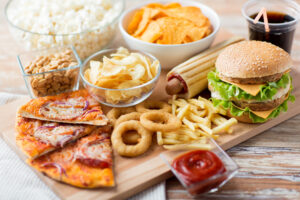
Fast Food ExamplesUltra-processed foods:

  • Usually go through several physical and chemical processes, such as extruding, molding, prefrying, and hydrogenation that can lead to the formation of toxic carcinogens that may increase the risk of colon cancer.
    • One example you may have heard about recently would be acrylamide in French fries. Another example would be nitrosamines in processed meats.
  • Are usually high in added sugar, fat, and refined starch which contribute to increased weight gain and obesity, an established risk factor for colon cancer.
  • Are usually low in phytonutrients, fiber, calcium, and vitamin D, which are known to reduce the risk of colon cancer
  • Typically contain ingredients of little or no nutritive value, such as refined sugar, hydrogenated oils, emulsifiers, artificial sweeteners, thickening agents, and artificial colors. Some of these ingredients, such as emulsifiers and artificial sweeteners, have been suggested to cause inflammation in the intestine, which is known to increase the risk of colon cancer.
  • Have long shelf-lives because of added preservatives. This allows migration of carcinogens such as bisphenol A from the packaging materials into the food.

Examples of ultra-processed foods include:

  • Sodas
  • Chips
  • Candy and packages of cookies or crackers
  • Most breakfast cereals
  • Boxed cake, cookie, and pancake mix
  • Chicken nuggets and fish sticks
  • Fast food burgers
  • Hot dogs and other processed meat
  • Infant formula
  • Instant noodles
  • Most store-bought ice cream
  • Flavored yogurt

How Was This Study Done?

clinical studyThis study used data collected from:

  • The Nurses’ Health Study (NHS) which enrolled 121,700 female nurses aged 30-55 in 1976 and followed them for 28 years.
  • The Nurses’ Health Study II (NHS II) which enrolled 116,429 female nurses aged 25-42 in 1989 and followed them for 24 years.
  • The Health Professions’ Follow-up Study (HPFS) which enrolled 51,529 male health professionals aged 40-75 in 1986 and followed them for 28 years.

After excluding participants who had incomplete data or a previous cancer diagnosis, the investigators running the study ended up with 67,425 women from NHS, 92,482 women from NHS II, and 46,341 men from HPFS for analysis.

Ultra-processed food consumption was scored as follows:

  • The dietary intake of each participant in the studies was assessed with a food frequency questionnaire every four years.
  • Each questionnaire was scored for the percentage of ultra-processed foods.
  • Then each participant in the study was ranked in terms of the percent ultra-processed foods in their diet averaged over the entire time they were enrolled in the study.
  • The participants were then divided into 5 groups based on the number of servings of ultra-processed foods/day they consumed, ranging from a high of 9 servings/day to a low of 3 servings/day.

Every two years the participants were asked to report any cancer diagnosis in the previous two years. Study physicians reviewed the medical records and pathology reports to confirm a diagnosis of colon cancer. If the patient had died, death certificates and medical records were used to confirm a diagnosis of colon cancer.

The investigators then compared the incidence of colon cancer in the group consuming the most ultra-processed foods to the group consuming the least ultra-processed foods.

  • These comparisons were adjusted for compounding factors like race, family history of cancer, history of endoscopy, physical activity, smoking status, alcohol use, aspirin use, menopausal status, and post-menopausal hormone use.
  • The comparisons were also adjusted for obesity and a healthy diet score called AHEI. I will explain the significance of these adjustments below.
  • Finally, the investigators looked at how various categories of ultra-processed food influenced the results.

Can Unhealthy Eating Give You Colon Cancer?

colon cancerHere is what the study found:

  • Men in the highest fifth of ultra-processed food consumption had a 29% higher risk of developing colon cancer than those in the lowest fifth.
  • No association between ultra-processed food consumption and risk of developing colon cancer was seen for women.

When they looked at subgroups of ultra-processed foods again comparing the top fifth in consumption with the lowest fifth:

  • Consumption of ultra-processed ready to eat products containing meat, poultry, or seafood increased the risk of colon cancer by 44% in men and 14% in women.
  • Consumption of sugar-sweetened beverages increased the risk of colon cancer by 21% in men but did not significantly affect risk of colon cancer in women.
  • Consumption of ultra-processed ready to eat mixed dishes increased the risk of colon cancer by 17% in women but did not significantly affect risk of colon cancer in men.
  • Consumption of ultra-processed dairy products decreased the risk of colon cancer by 17% in women but did not significantly affect risk of colon cancer in men.

The reason for the differing effect of poor diet on the risk of colon cancer in men and women is not clear, but it has been observed in previous studies.

The investigators concluded, “…high consumption of total ultra-processed foods in men and certain subgroups of ultra-processed foods in men and women was associated with an increased risk of colorectal cancer. Further studies are needed to better understand the potential attributes of ultra-processed foods that contribute to colorectal carcinogenesis.”

What Does This Study Mean For You?

There are several take-home lessons from this study:

1: The 29% increase in colon cancer risk reported for men probably underestimates the true risk. I say that because:

  • Ultra-processed food consumption increases the likelihood that you will gain weight, and obesity is a known risk factor for colon cancer. However, the 29% number was obtained after adjusting the data for obesity. Without that adjustment the increased risk would have been greater
  • Ultra-processed foods are low in the protective phytonutrients and fiber provided by fruits, vegetables, and whole grains. However, the 29% number was obtained after adjusting the data for a healthy eating index (which includes the amounts of fruits, vegetables, and whole grains in the diet). Without that adjustment the increased risk would have been greater.

2: While we don’t know the mechanism(s) for the increased risk of colon cancer reported in this study, we can make some informed guesses. I say that because:

  • Once you have removed obesity and fruits, vegetables, and whole grains from consideration, you are left with:
    • The effect of ultra-processed foods on your gut bacteria.
    • The additives, preservatives, and other potentially carcinogenic chemicals in ultra-processed foods.

3: Finally, don’t think you are off the hook if you are a woman.

  • As I mentioned in the introduction, ultra-processed foods also increase your risk of obesity, diabetes, and breast cancer.

And that brings us back to what I said at the beginning of this article, “If you are like millions of Americans, you may already be making a list of New Year’s resolutions and “checking it twice”. If weight loss and a healthier diet are important to you, you may want to put cutting back on ultra-processed foods at the top of your list.”

The Bottom Line 

A recent study showed that ultra-processed food consumption increased the risk of colon cancer in men, but not in women. The reason for the differing effect of ultra-processed foods on the risk of colon cancer in men and women is not clear, but it has been observed in previous studies on the effect of poor diet on colon cancer risk.

However, don’t think you are off the hook if you are a woman. Previous studies have shown that ultra-processed food consumption increased the risk of obesity, diabetes, and total cancers in both men and women and the risk of breast cancer in women.

The investigators concluded, “…high consumption of total ultra-processed foods in men and certain subgroups of ultra-processed foods in men and women was associated with an increased risk of colorectal cancer.”

That brings me to my recommendation. “If you are like millions of Americans, you may already be making a list of potential New Year’s resolutions and “checking it twice”. If weight loss and a healthier diet are important to you, you may want to put cutting back on ultra-processed foods at the top of your list.”

For more details on this study and what it means for you, read the article above.

These statements have not been evaluated by the Food and Drug Administration. This information is not intended to diagnose, treat, cure, or prevent any disease.


Health Tips From The Professor