An Unexpected Benefit Of NAD+ Boosters
Author: Dr. Stephen Chaney
 NAD+ is required for cellular energy production and hundreds of other essential cellular reactions. However, NAD+ levels decrease as we age. And, less than 5% of NAD+ in the blood is taken up by the cell, so we can’t make up for the age-related deficit by supplementing with NAD+.
Because there are clear benefits of NAD+ for an ageing population and its potential benefits for longevity, NAD+ boosting supplements have become very popular. But which of the NAD+ boosting supplements is best for increasing cellular NAD+ levels?
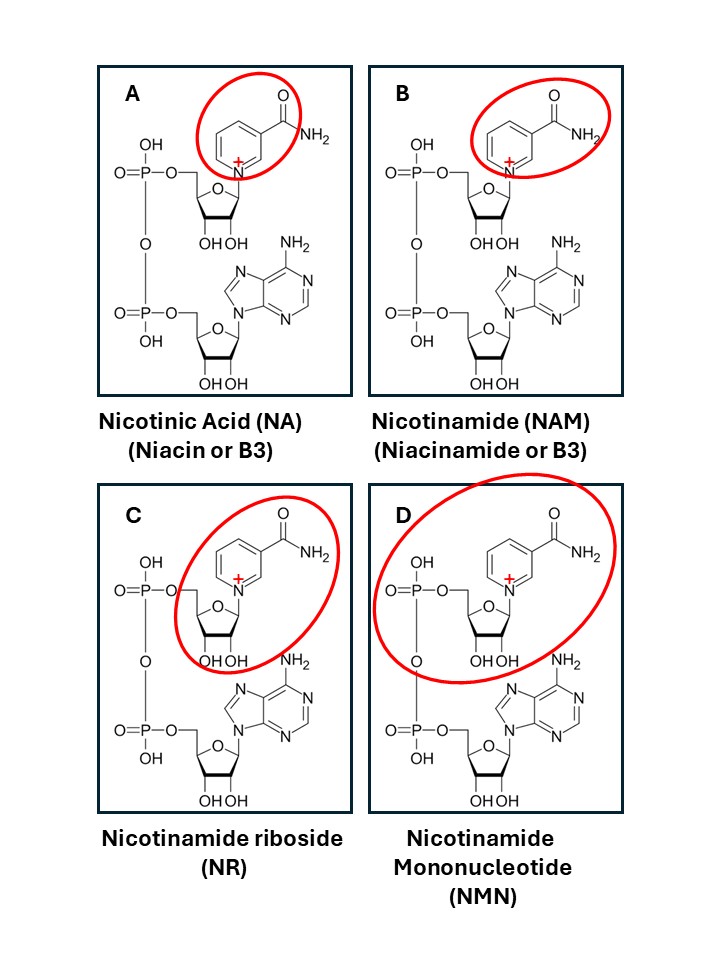
There are lots of NAD+ boosters on the market, but the three most popular, and one that isn’t used for this purpose, are shown above.
When you look at the figure, it is easy to see that each of the molecules circled in red are precursors of NAD+. But let me explain the figure in more detail. The large molecule shown in each panel of the figure is nicotinamide adenine dinucleotide or NAD+ with the positive charge shown in red.
Panel A shows nicotinic acid or niacin (abbreviated as NA), a form of vitamin B3. It is found at low levels in most multivitamins and B complex supplements. However, it is not suitable for use as a NAD+ booster because high doses are associated with skin flushing and uncomfortable gastrointestinal symptoms.
Panel B shows nicotinamide (abbreviated as NAM) or niacinamide, another form of vitamin B3. This is the form of vitamin B3 used when higher doses are appropriate because it does not have the same side effects as niacin (nicotinamide).
Panel C shows nicotinamide riboside, abbreviated as NR.
Panel D shows nicotinamide mononucleotide, abbreviated as NMN.
As I said above, there are other NAD+ boosting supplements on the market, but NAM, NR, and NMN are the most popular. There are individual studies suggesting that each of these compounds may be a useful NAD+ booster, but they have never been directly compared in a single human clinical trial.
The authors of the current study ( S Christen et al, Nature Metabolism, vol 8: 62-73, 2026) decided to fill this void by comparing all three NAD+ precursors under identical conditions in a clinical study.
How Was This Study Done?
 The authors of this study recruited 65 participants (32 men and 33 women) with an average age of 35 years and an average BMI of 21.4 for females and 23.7 for males. In other words, this was a relatively young population at a healthy weight.
The exclusion criteria for this study included:
- No acute or chronic medical conditions.
- No use of drugs known to interact with NAD+ metabolism.
- No use of vitamin supplements containing any form of vitamin B3 or any NAD+ boosting supplement for at least 30 days prior to the study.
This was a randomized, double-blind, placebo-controlled study. The participants were divided into 4 groups. The groups received equivalent doses of nicotinamide (NAM), nicotinamide riboside (NR), nicotinamide mononucleotide (NMN), or placebo on a daily basis for 14 days.
Whole blood levels of NAD+ were determined in both acute phase (the first 4 hours after a single administration) and chronic phase (days 1 through 14). [Note: Whole blood measures NAD+ levels in the blood and NAD+ levels in the white cells (Mostly cells of the immune system).]
Which Supplements Are Best For Boosting NAD+ Levels?
 The results with chronic supplementation were:
- After 14 days, chronic supplementation by both NR (nicotinamide riboside) and NMN (nicotinamide mononucleotide) increased NAD+ levels in whole blood by approximately two-fold compared to placebo.
- In contrast, chronic supplementation with NAM (nicotinamide) had no significant effect on whole blood NAD+ levels.
- There was no significant effect of sex or age on the results.
The results with acute supplementation were the opposite:
- NAM (nicotinamide) significantly (2.5-14-fold, depending on day measured) increased whole blood NAD+ levels at 4 hours.
- NR (nicotinamide riboside) and NMN (nicotinamide mononucleotide) had no significant effect on whole blood NAD+ levels at 4 hours.
The authors said, “In conclusion, this head-to-head comparison of three NAD+ precursors in healthy adults shows that NR and NMN are comparable in their ability to chronically increase baseline whole-blood NAD+ levels, while NAM provides only an acute transient effect.”
Overall, this was a well-done study, but I have two concerns:
#1: It was done with young, healthy, and normal weight adults, while those most likely to benefit from NAD+ boosters are over 50 and overweight.
#2: It was done with whole blood. It did not distinguish between NAD+ levels in blood and white blood cells, and only cellular NAD+ levels are of metabolic significance
An Unexpected Benefit of NAD+ Boosters
 The authors of this study were also interested in determining the effect of these NAD+ boosters on the gut microbiome. To test that they performed what is called an “ex vivo” experiment.
Specifically, they isolated gut bacteria from stool samples obtained from healthy adults and incubated them with NAM (nicotinamide), NR (nicotinamide riboside), or NMN (nicotinamide mononucleotide) for 48 hours.
The findings were:
- All three NAD+ boosters were at least partially broken down to NA (nicotinic acid or niacin) and NA:
-
- Stimulated the growth of friendly bacteria.
-
- Increased the production of short-chain fatty acids like acetate, propionate, and butyrate. [Previous studies have shown that these fatty acids are absorbed from the intestine and have beneficial metabolic effects.]
The authors concluded, “This suggests that the oral intake of NR and NMN and their metabolite NA may offer dual benefits: a sustained increase in systemic NAD+ levels and enhanced gut health.”
My main concern is that this study was performed ex vivo. The results have not been confirmed in a clinical study.
The Bottom Line
A recent study has looked at the three most popular NAD+ boosting supplements to determine which was most effective at producing a sustained increase in whole blood NAD+ levels and discovered an unexpected benefit of these NAD+ boosting supplements in the process.
For more information on which supplement(s) is/are best and the unexpected benefit, read the article above.
These statements have not been evaluated by the Food and Drug Administration. This information is not intended to diagnose, treat, cure or prevent any disease.
___________________________________________________________________________________________
My posts and “Health Tips From the Professor” articles carefully avoid claims about any brand of supplement or manufacturer of supplements. However, I am often asked by representatives of supplement companies if they can share them with their customers.
My answer is, “Yes, as long as you share only the article without any additions or alterations. In particular, you should avoid adding any mention of your company or your company’s products. If you were to do that, you could be making what the FTC and FDA consider a “misleading health claim” that could result in legal action against you and the company you represent.
For more detail about FTC regulations for health claims, see this link.
https://www.ftc.gov/business-guidance/resources/health-products-compliance-guidance
____________________________________________________________________________________
About The Author
 Dr. Chaney has a BS in Chemistry from Duke University and a PhD in Biochemistry from UCLA. He is Professor Emeritus from the University of North Carolina where he taught biochemistry and nutrition to medical and dental students for 40 years. Dr. Chaney won numerous teaching awards at UNC, including the Academy of Educators “Excellence in Teaching Lifetime Achievement Award”.
Dr Chaney also ran an active cancer research program at UNC and published over 100 scientific articles and reviews in peer-reviewed scientific journals. In addition, he authored two chapters on nutrition in one of the leading biochemistry text books for medical students.
Since retiring from the University of North Carolina, he has been writing a weekly health blog called “Health Tips From the Professor”. He has also written two best-selling books, “Slaying the Food Myths” and “Slaying the Supplement Myths”. And most recently he has created an online lifestyle change course, “Create Your Personal Health Zone”. For more information visit https://chaneyhealth.com.
For the past 54 years Dr. Chaney and his wife Suzanne have been helping people improve their health holistically through a combination of good diet, exercise, weight control and appropriate supplementation.